SIP Calculator
Enter a monthly investment amount, an expected return rate, and how long you'll keep investing to see what it could grow into.
Nothing you type here is sent to a server or saved — every number above is calculated by your browser, on your device.
What This Calculator Actually Tells You
Say you've just started your first job, or you've decided this is the year you stop leaving money in a savings account earning next to nothing. You can commit to putting away a fixed amount every month, and you want to know what that habit could actually turn into ten or twenty years from now.
That's what this tool works out. Enter a monthly amount, an expected annual return, and how many years you'll keep it up, and it projects the maturity value using compound interest applied every month — the same mechanics behind a mutual fund SIP's long-term growth chart.
It won't tell you which fund to pick or promise that 12% is realistic for your particular investment (more on that below). What it does is turn "I'll invest ₹2,000 a month" into an actual rupee figure, so the habit has a number attached to it.
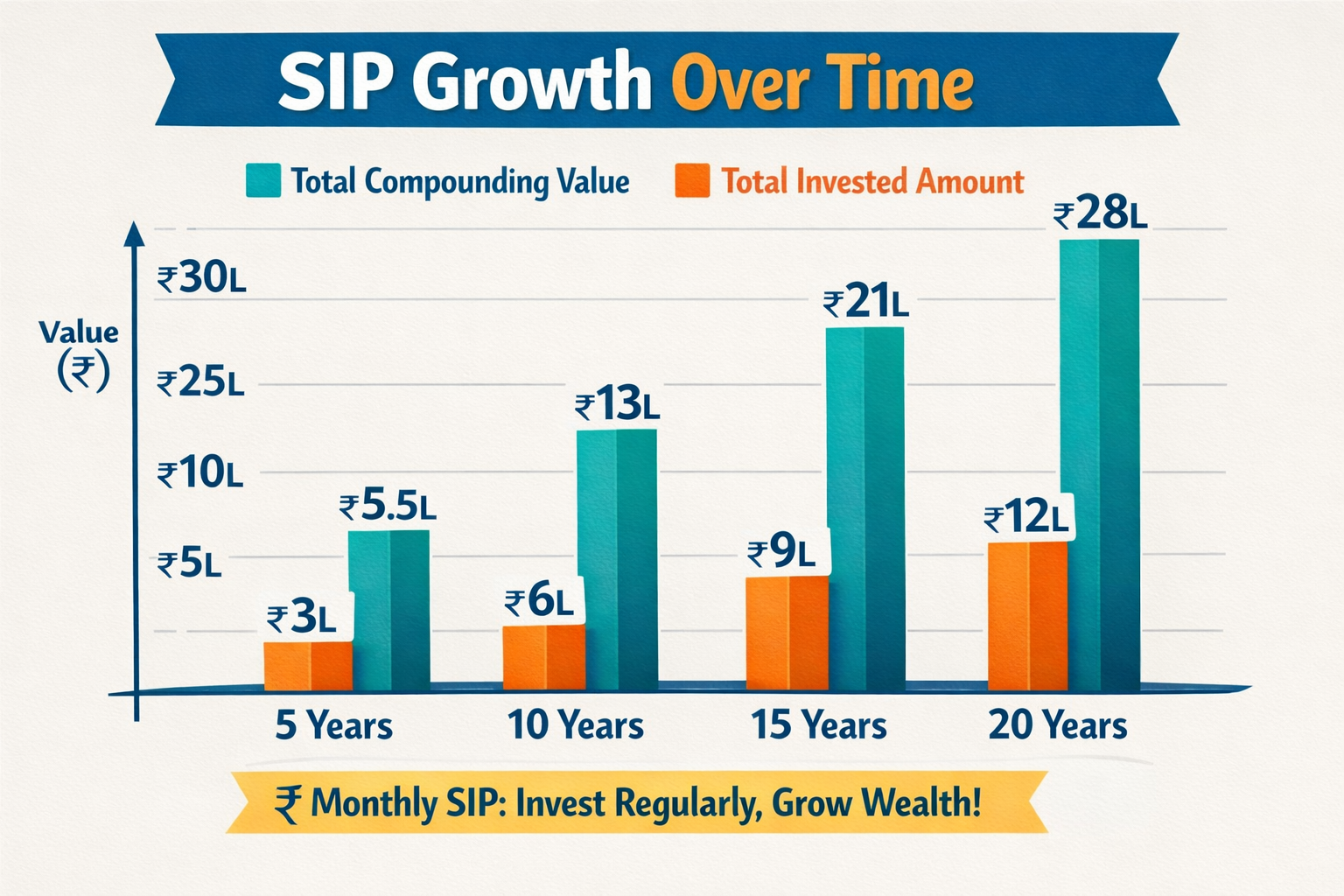
How the Math Works
Unlike a lump sum, a SIP doesn't get invested all on day one — a fixed amount goes in every month, and each individual deposit compounds for however long is left until the end of the term. The formula behind it is:
M = P × ({[1 + i]n – 1} / i) × (1 + i)
- M — Maturity amount, what you end up with
- P — Your fixed monthly investment
- n — Total number of monthly deposits (years × 12)
- i — Monthly rate of return (annual rate ÷ 12)
Why earlier SIP contributions grow more than later ones
Each bar shows how much a single month's ₹1 contribution grows by year 20 of a 20-year, 12% SIP, depending on which month it went in. The very first deposit gets the full 20 years to compound; the very last one barely gets any time at all — which is why the total months you stay invested usually matters more than squeezing out a slightly higher return.
Here's the same idea with real numbers. Say you invest ₹1,000 every month for 12 months at an expected annual return of 12%. First, convert that to a monthly rate:
Monthly rate (i) = 12% ÷ 12 = 1% = 0.01
Step by step:
M = 1,000 × (( (1 + 0.01)12 − 1 ) / 0.01 ) × (1 + 0.01)
M = 1,000 × 12.6825 × 1.01
M ≈ ₹12,809
Over just one year the gap between what you put in (₹12,000) and what you end up with (₹12,809) looks small — around ₹809. That's normal. Compounding is slow at the start and only starts looking dramatic once you let it run for a decade or more, which is exactly what the scenarios below show.
For a smaller, longer example: ₹2,000 a month for 5 years at 10% grows to roughly ₹1,56,165 against ₹1,20,000 invested — about ₹36,165 in returns. Still modest, but note it took 5 years instead of 1 to get there, not just a bigger monthly number.
Keep in mind SIP returns aren't fixed — they depend entirely on how the underlying fund performs, and the actual number can land above or below anything shown here.
A Few More Growth Scenarios
Same formula, different inputs. These numbers match exactly what the calculator above would show if you entered the same figures.
| Monthly SIP | Return Rate | Duration | Total Invested | Approx. Maturity Value |
|---|---|---|---|---|
| ₹1,000 | 10% | 10 years | ₹1,20,000 | ₹2,06,552 |
| ₹2,000 | 12% | 15 years | ₹3,60,000 | ₹10,09,152 |
| ₹5,000 | 12% | 20 years | ₹12,00,000 | ₹49,95,740 |
| ₹10,000 | 12% | 20 years | ₹24,00,000 | ₹99,91,479 |
| ₹15,000 | 14% | 25 years | ₹45,00,000 | ₹4.09 crore |
These are illustrative projections at assumed rates, not promised returns. Actual investments can underperform or outperform any of the rates shown here.
SIP or Lump Sum — An Honest Comparison
Run the numbers on ₹1,000 a month for 10 years against a ₹1,20,000 lump sum invested on day one, both at 12%, and the lump sum comes out ahead — by a wide margin. That's not a knock against SIPs; it's just what happens when the entire amount gets a full 10-year head start instead of building up gradually. The SIP's last few deposits barely have any time to grow at all.
| Criteria | SIP (₹1,000/month) | Lump Sum (₹1,20,000 one-time) |
|---|---|---|
| Duration | 10 years (120 months) | 10 years |
| Total invested | ₹1,20,000 | ₹1,20,000 |
| Expected return | 12% (compounded monthly) | 12% (compounded annually) |
| Approx. maturity value | ₹2,32,339 | ₹3,72,702 |
| Approx. returns | ₹1,12,339 | ₹2,52,702 |
| Market timing risk | Lower — spread across 120 entry points | Higher — one entry point for the full amount |
| Realistic for | Someone investing out of a monthly salary | Someone with ₹1,20,000 already sitting idle |
| Try it | You're already here | Open the Lump Sum Calculator |
The honest takeaway isn't "lump sum wins" — it's that this comparison only holds if you actually have ₹1,20,000 sitting idle today. Most people don't, which is the entire reason SIPs exist: they let you get the same 12% working for you using money you haven't earned yet.
Why Starting Early Matters More Than Starting Big
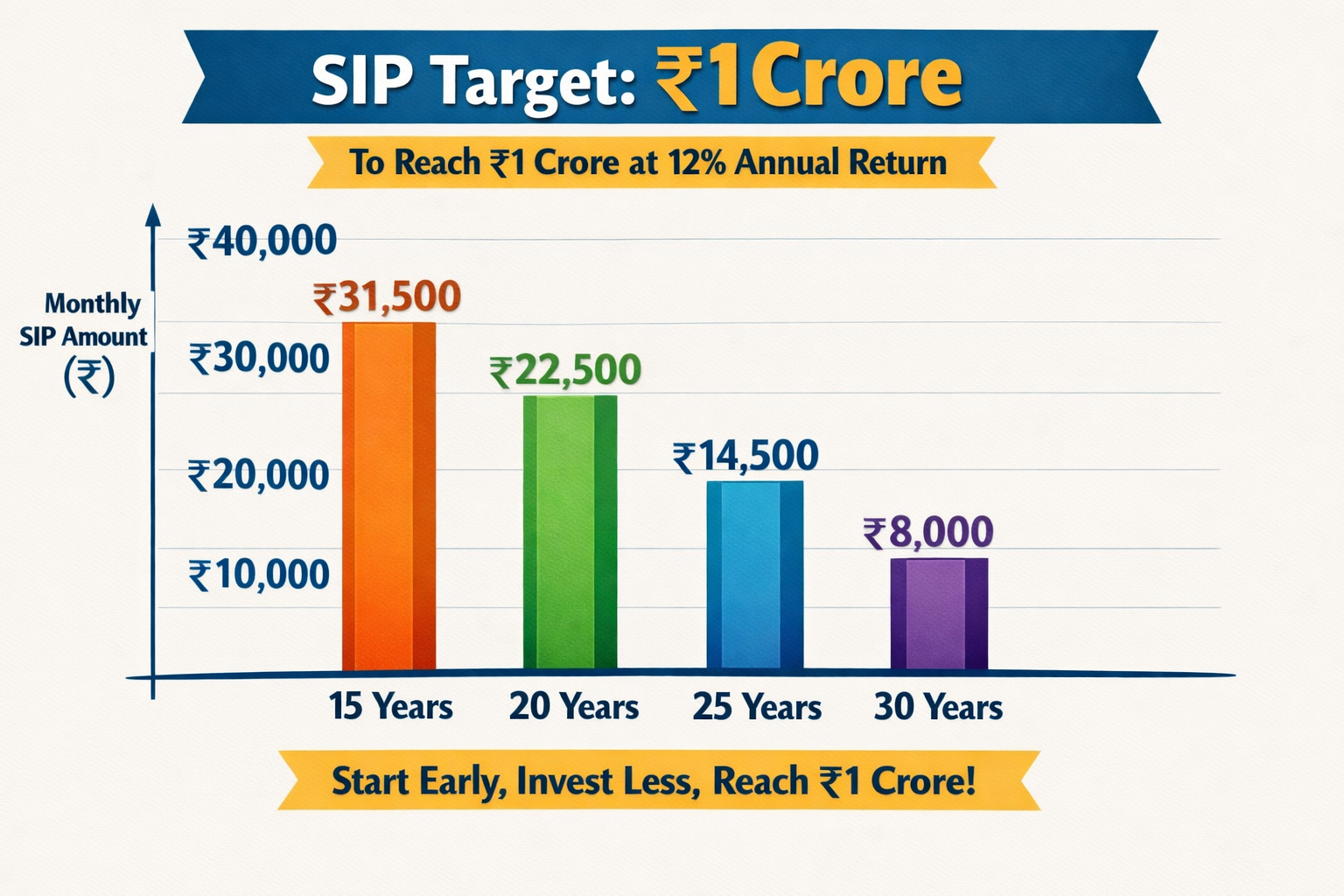
Here's a comparison worth sitting with: to reach ₹1 crore at 12% annual returns, you'd need to invest roughly ₹19,819 a month if you only have 15 years left, but just ₹2,833 a month if you have 30 years. That's a nearly 7x difference in monthly commitment for the same destination — purely because of how many years compounding had to work.
| Years to Invest | Monthly SIP Needed for ₹1 Crore @ 12% |
|---|---|
| 30 years | ≈ ₹2,833 |
| 25 years | ≈ ₹5,270 |
| 20 years | ≈ ₹10,009 |
| 15 years | ≈ ₹19,819 |
A 25-year-old and a 35-year-old chasing the same retirement number aren't playing the same game — the 25-year-old's decade head start does more work than most people expect. If retirement is the goal, run this calculator with your actual timeline before deciding the monthly number feels "too small" to bother with.
Mistakes Worth Avoiding With a SIP
The math is simple; sticking to it isn't. These are the slip-ups that quietly cost the most over time:
| Mistake | Why it hurts | A steadier approach |
|---|---|---|
| Pausing the SIP when the market drops | You skip buying at lower prices, which is exactly when SIPs are supposed to help most | Keep the SIP running through downturns unless your income situation genuinely changed |
| Never increasing the monthly amount | Your SIP stays flat while your income (hopefully) rises, so it becomes a smaller part of your finances over time | Step up the amount by 5–10% each year as your salary grows |
| Ignoring an ELSS fund's 3-year lock-in | You can't withdraw a given month's ELSS contribution until 3 years after that specific deposit | Only put ELSS money toward goals at least 3-plus years out |
| Picking a duration that doesn't match the actual goal | You either exit too early and miss compounding, or plan for a goal that arrives sooner than the fund is ready | Set the time period field to match your real goal date, not a round number |
| Choosing a fund based on last year's best return | Last year's top performer is rarely next year's, and the rate you plug in becomes unrealistic | Use a longer-run average return, and test the calculator at a lower rate too |
How to Use This Calculator
Three fields, one result:
- Enter your monthly SIP amount
- Set an expected annual return rate
- Choose how many years you'll keep investing
The results update instantly as you type or drag the sliders, and the chart below switches between a bar and line view so you can see the year-by-year climb, not just the final number.
Frequently Asked Questions
Last updated: 7 July 2026 ·
Related Calculators
- Lump Sum Calculator — see what a one-time investment could grow into